
Paragliding vs. Parasailing
People mix up paragliding and parasailing more than any other pair of air sports, and the names deserve most of the blame. Both start with "para", both hang you under a fabric canopy, and from the beach both look like someone floating on a string. Up close they are different animals. Parasailing is a boat ride where the boat tows you overhead like a kite. Paragliding is free flight in an engineless aircraft, steered by a pilot who reads the wind. Here is how each one works, what they cost, why San Francisco has one and does not have the other, and how to pick your first flight.
How parasailing works
A parasail is a towed canopy, closer to a parachute than to a wing. You board a boat, buckle into a harness on the back deck, and the crew clips you to the canopy while a hydraulic winch pays out 300 to 800 feet of line. The boat's speed lifts you off the deck, you ride above the water for 8 to 12 minutes while the captain drives a loop, and the winch reels you back in. You never touch a control, and nobody flies beside you. The captain runs everything from below.
That is the appeal. Riders as young as five go up at most operations, and two or three people can fly together on the same bar. Ask nicely and the crew will dip your toes in the water on the way down. It is the tallest swing ride at the fair with a much better view, and the whole outing runs about an hour dock to dock.
How paragliding works
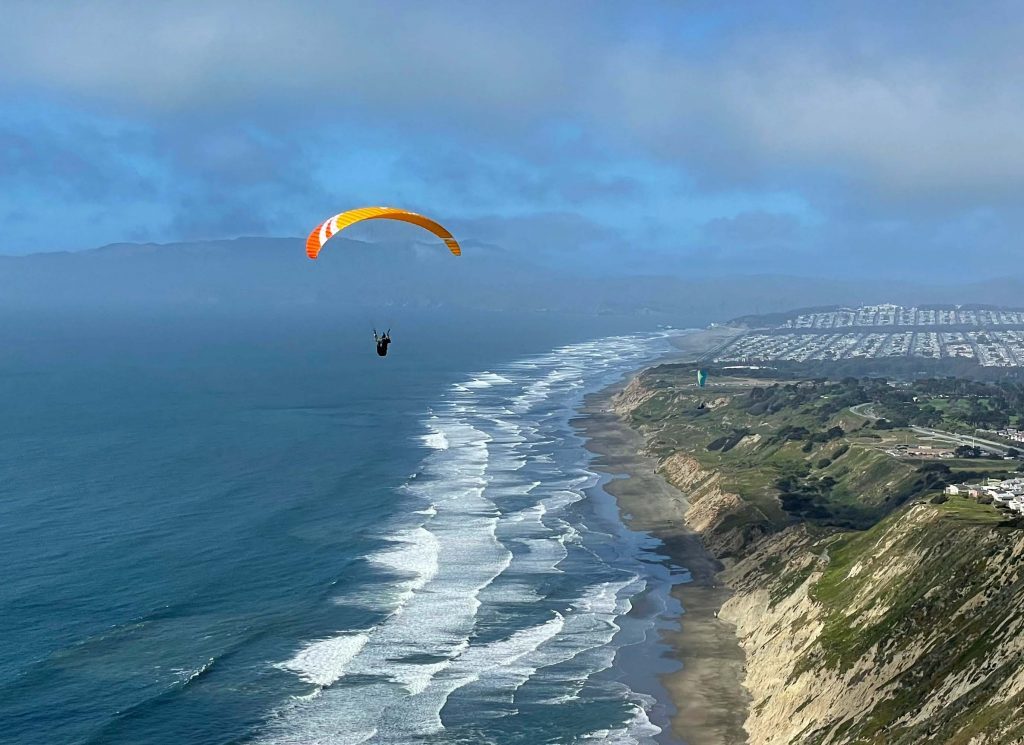
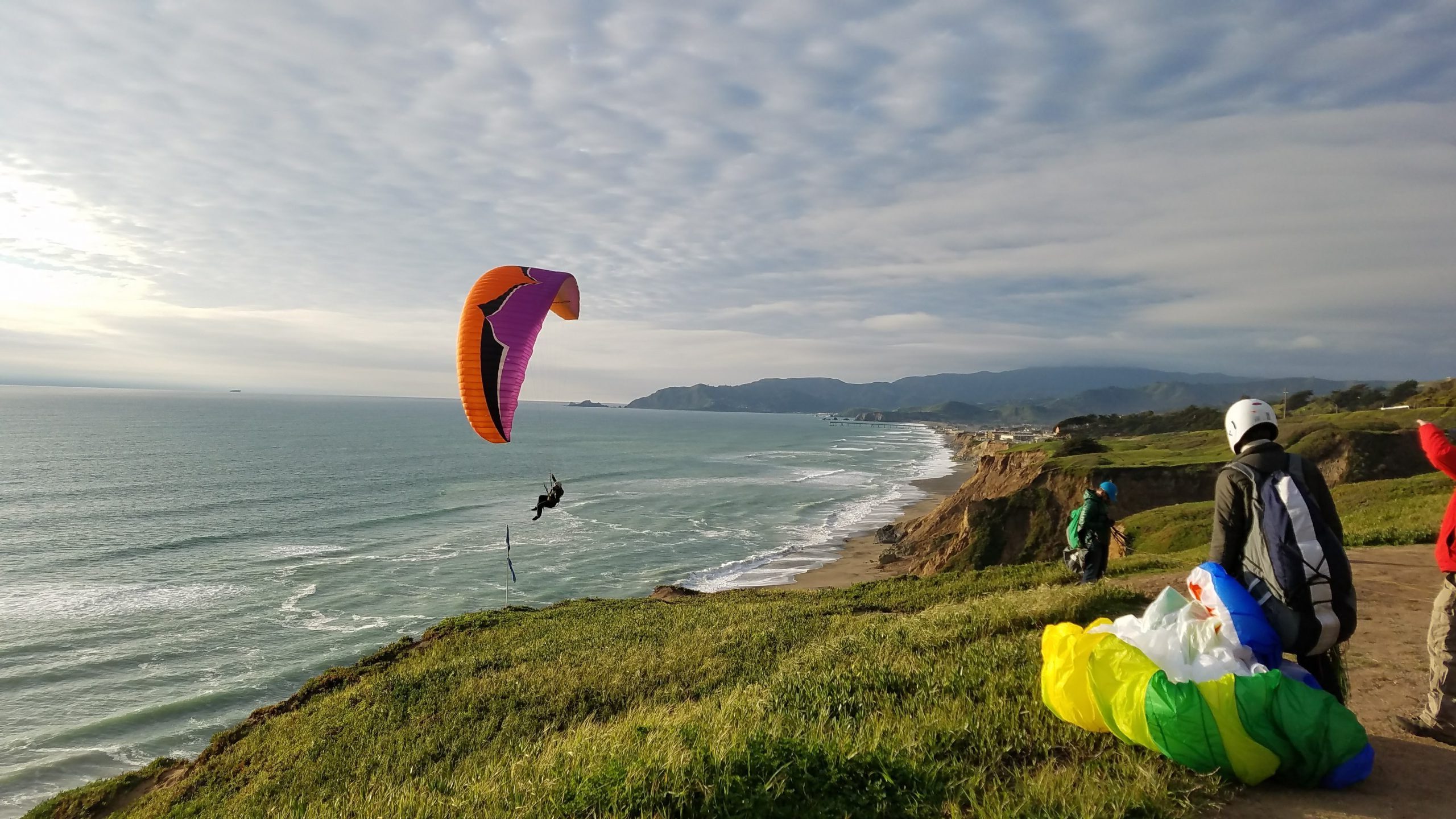
A paraglider is an aircraft the FAA regulates under its ultralight rules. The wing is a long curved airfoil built from fabric cells that inflate with moving air, and the pilot steers it with a brake line in each hand. There is no rope back to a boat and no motor. On a tandem flight you clip into a harness in front of a certified pilot, take a few running steps down the launch slope, and the wing lifts you both off the ground. From there the pilot surfs lift along the terrain, climbing where the air rises and turning back before it stops.
At Mussel Rock, the coastal site 15 minutes south of San Francisco where we fly, the ocean wind hits the bluffs and deflects upward, so a tandem can cruise back and forth a few hundred feet over the beach for 20 to 30 minutes. Your pilot will often hand you the brake toggles once you settle in, which means you fly a real aircraft on your first day. Tandem pilots here are certified through USHPA, the national association for the sport.
Where each one came from
Parasailing started as a training shortcut. In the early 1960s the French engineer Pierre-Marcel Lemoigne designed an ascending parachute that let student parachutists get airborne behind a tow vehicle without needing an airplane, and resorts soon noticed that tourists would pay for the ride itself. Beach operations spread through the 1970s, and once purpose-built winch boats arrived in the 1980s, riders could launch and land on deck without getting sand in anything. Today it is a fixture of warm-water vacation towns from Cancun to Lake Tahoe.
Paragliding grew out of the parachute too, but it kept going. Climbers in the French Alps spent the mid-1980s running off summits under steerable ram-air canopies as a fast way down. Manufacturers began building wings meant for soaring rather than descending, and within a decade paragliding had become the most popular form of free flight on earth. The longer version of that story is in our paragliding vs. hang gliding post.
Paragliding vs. parasailing: the main differences
The short version: one is a flight, the other is a ride. The table compares the versions you can actually book in Northern California.
| Paragliding | Parasailing | |
|---|---|---|
| The experience | Free flight in an engineless aircraft | A ride under a canopy towed by a boat |
| Who is in control | A certified pilot flying with you | The boat captain, from the water below |
| Getting airborne | A few running steps off a coastal bluff | Winched up off the back deck |
| Time in the air | 20 to 30 minutes | 8 to 12 minutes |
| Steering | Yes, and you may get to try it | None, you hang and watch |
| Typical height | A few hundred feet over the bluffs | 300 to 800 feet of line, up to about 1,000 |
| Near San Francisco | Year-round at Mussel Rock, 15 minutes away | Lake Tahoe, 3.5 to 4 hours away, May through September |
| Getting wet | No, you launch and land on land | Only if you ask for a dip |
| Cost to try | $189 per person | About $95 to $120 per person at Lake Tahoe |
| Age and weight limits | Ages 14 and up | Usually age 5 and up, 200 to 450 lb combined |
Why San Francisco has no parasailing
There is no parasailing in San Francisco, on the Bay or on the ocean side. The water sits in the 50s all year, the afternoon wind is too strong and too gusty for a tow boat trying to hold a steady line, the fog can erase visibility in twenty minutes, and the Bay itself is a working shipping lane. The closest commercial parasailing is at Lake Tahoe, a 3.5 to 4 hour drive, where a handful of operators fly from May through September. Our Parasailing San Francisco guide lists them all with current prices.
The same relentless coastal wind that rules out tow boats is exactly what makes this one of the best paragliding regions in the country. Ocean air rises smoothly up the Mussel Rock bluffs and holds a wing aloft for as long as the pilot cares to stay, on the same afternoons that would keep every tow boat in the harbor. Most people who go looking for parasailing near San Francisco end up booking a tandem paraglide instead, and they come home with the longer flight.
Which one should you pick?
Parasailing earns its place. If you are already at Tahoe with the family and want ten easy minutes over blue water with zero effort, it is a lovely ride at a fair price. Book it and ask for the dip.
If what you actually want is to fly, book the paraglider. You get 20 to 30 minutes in the air rather than ten, with a pilot beside you who may hand you the controls partway through. It runs year-round 15 minutes from the city rather than four hours away for four months of the year, and at $189 it costs about what two Tahoe parasail tickets do. Our pilots have flown tandems at Mussel Rock for 22 years with a perfect safety record, and first-timers from age 14 to 97 are welcome. You can book a tandem flight online in a few minutes.
Frequently asked questions
What is the difference between paragliding and parasailing?
Can you parasail in San Francisco?
Is parasailing or paragliding safer?
Which one is scarier?
Do you get wet?
How long does each one last?
How much does each one cost?
Keep exploring
- Book a tandem paragliding flight
- Parasailing San Francisco guide
- Is Paragliding Safe?
- Paragliding vs. Hang Gliding
- What to expect on your first tandem flight
- Bay Area Adventure Guide
Ready to trade the tow rope for a wing? Book a tandem paragliding flight and get 20 to 30 minutes in the sky, 15 minutes from San Francisco.